
 JOIN
JOINOn 10 March, the European Parliament adopted its position on AI and copyright in plenary session. No further amendments were tabled following the committee vote, and the final report reflects the version previously available. The text stops short of recommending a reopening of the 2019 EU Copyright Directive, but acknowledges its ambiguous application in the AI context, supports voluntary licensing for AI, and strikes a generally positive tone.
Author: Felicia Bowling
IFRRO releases study on publishing industry in Asia-Pacific
IFRRO has published a comparative regional analysis of publishing markets across Asia-Pacific, covering market segmentation, revenue and growth trends, digital transformation, copyright and open access frameworks, and the evolving impact of artificial intelligence. An extended version — a 200+ page document featuring detailed analysis of 13 focus countries — will also be made available.
UK Publishers Association publishes comprehensive account of AI content licensing
The Publishers Association has released a detailed report on how book and journal publishers license content for AI use — finding that the AI licensing market is established and growing, with high-quality publisher content increasingly in demand to power AI innovation and scientific discovery.
Key findings include:
- The AI licensing market has firm foundations, with publishers licensing content for text and data mining (TDM) for over a decade, AI training deals emerging by 2023, and licensing for retrieval-augmented generation (RAG) now a meaningful and growing segment.
- The market is expanding rapidly, with the number of publishers active in licensing set to almost double this year — expected to include all major academic publishers.
- As data becomes a key differentiator between AI models, high-quality publisher content is increasingly valued and represents a significant area of competitive advantage for the UK.
EU Commission adopts draft Council recommendation on science diplomacy
The European Commission has adopted draft Council recommendations on science diplomacy, which will now be discussed by national delegations ahead of final adoption in May 2026. Academic publishers are recognised as non-state actors in science diplomacy — acknowledged for their expertise, international networks, and innovative capacity to open new avenues for innovation and strengthen global partnerships beyond traditional channels.
The science diplomacy document was released alongside a country monitor on research security, underscoring the complementary nature of the two areas in the current geopolitical context.
STM meets with EVP Virkkunen and Commissioner Zaharieva’s Cabinet
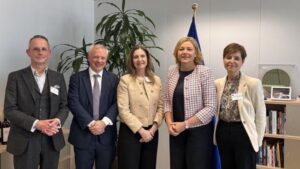 STM organised a delegation of senior member representatives to meet with European Commission Executive Vice-President Henna Virkkunen, as well as with the Cabinet of Commissioner Zaharieva. The meetings provided an opportunity to present key trends, opportunities, and challenges facing the industry, and to discuss the AI-driven innovation underway across our sector.
Science funding slow to come to researchers
Although almost all federal agencies have had approved budgets for Fiscal Year 2026 for more than a month — the Department of Homeland Security being the exception — science agencies have reportedly not been cleared to spend much of the appropriated funding.
This has led to delays in universities receiving funding for already-approved grants, and even longer delays in the review and issuance of new ones. Democrats in Congress are calling on the White House Office of Management and Budget to release the funds.
STM supports transparency in AI training
STM has expressed support for Congressional efforts to legislate on AI transparency, with several bills proposed to require AI developers to disclose the use of copyrighted material.
The TRAIN Act grants rightsholders the ability to petition courts to subpoena developers to release generative AI training data. The CLEAR Act would require generative AI developers to disclose, available via a Copyright Office database, detailed summaries of the copyrighted works used during training for all publicly accessible models.
STM CEO Caroline Sutton provided supportive quotes regarding the goals of both of these bills, and will be working with the bills’ sponsors on details if they move forward in the legislative process.
EU Commission releases report on ERA Act consultation
Following the call for evidence on the ERA Act open between 6 August and 10 September 2025, the EU Commission released a summary of stakeholders’ responses. A fragmented copyright landscape, the lack of standardised metadata and interoperable data infrastructures, inequities arising from APCs, dominance of English in scientific publishing, reliance on commercial publishers and restrictive contractual practices were identified as obstacles to the free circulation of knowledge (Section 7.2.). Several stakeholders called for the harmonisation of legal frameworks, particularly concerning copyright exceptions and secondary publishing rights as a way forward. STM is engaging with the EU Commission regarding the potential proposal of some of these measures.
STM submitted comments on copyright and AI in India
On 6 February, STM finalised its submission to the Department for Promotion of Industry and Internal Trade (DPIIT) in response to the Working Paper on Generative Artificial Intelligence and Copyright, which proposed introducing a statutory licensing scheme for AI. Other global and local publishing organisations, as well as additional rightsholders, also made submissions. STM will continue to monitor developments and engage with stakeholders in India.
NSF implements immediate public access requirements
On January 22, NSF announced an immediate update to its public access policies in its Proposal and Award Policies and Procedures Guide (PAPPG). Effective immediately for new “financial assistance awards,” NSF grant recipients are required to deposit an accepted manuscript to the NSF Public Access Repository (PAR) immediately “at or before the time of publication.”
On the positive side, the new Guide explicitly allows payment of APCs, referred to as “special fees for the purpose of making published versions of record (VORs) publicly accessible.” The Guide also includes language reaffirming that copyright belongs to the author and encourages — but does not require — the use of permissive reuse licenses for publications.