
 JOIN
JOIN
Embracing AI for Discovery and Impact
STM members are excited about the transformative potential of AI — particularly Generative AI — in advancing scientific discovery. From enhancing the quality and accessibility of published content to streamlining workflows, AI offers powerful tools to support researchers and strengthen the research ecosystem.
Yet in all of this innovation, we recognize that scholarly knowledge has a lineage—a traceable history shaped by human insight, editorial care, and rigorous review. As publishers explore and apply AI, they do so with a clear commitment to preserving this genealogy of knowledge. It is this continuity that ensures new technologies serve science without compromising its integrity.
Publishers are leading in three core areas of AI engagement — alongside ongoing work around the responsible use of research content for LLMs (more to come soon on this):
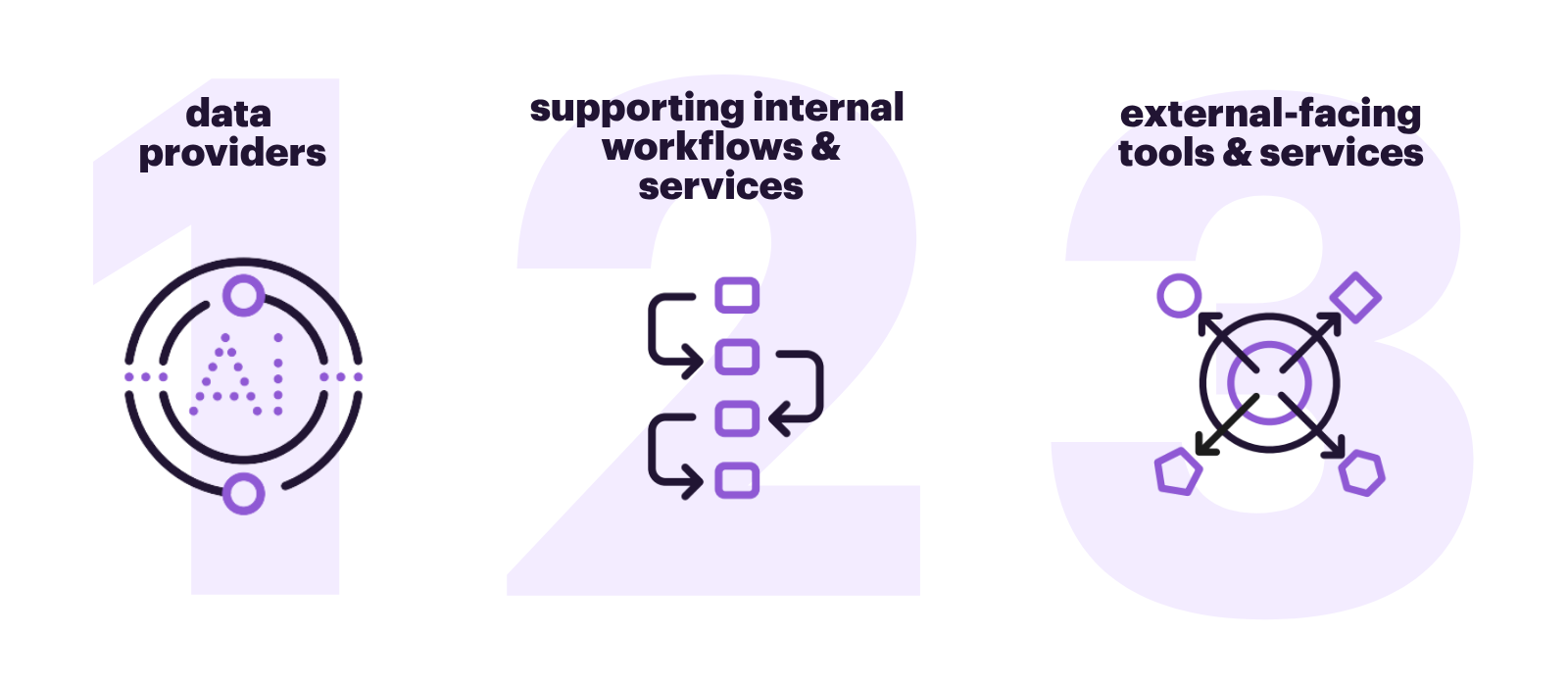

AI has become an integral part of how research is shared and improved—supporting everything from editorial workflows to personalized discovery. It supports:
- Article recommendations and dynamic classification
- Enhanced search and browse functionality
- Image validation and annotation
- Authorship and editorial matching
- Content enrichment and structuring
Such integration enables better access to knowledge and streamlines the dissemination of trustworthy research. (Source: AI Ethics in Scholarly Communication).
The role of AI in peer review is at the center of an active and rapidly evolving debate. Perspectives are shifting, and the following resources offer valuable insights to help navigate this critical conversation.
Our members have long pioneered the responsible use of AI, applying it to content creation, workflow optimization, and the development of innovative tools.
Clarivate
Elsevier
- ScienceDirect AI: Eureka, every day | Elsevier
- Elsevier takes Scopus to the next level with generative AI
- Elsevier introduces Embase AI to transform how users discover, analyze and draw critical insights from biomedical research
- Elsevier introduces Reaxys AI Search, enabling faster and more accessible chemistry research through natural language discovery
- LeapSpace | The research-grade AI workspace
OUP
Research Information
Silverchair
- Silverchair’s AI Lab Delivers Oxford Academic AI Discovery Assistant for Dynamic Research Support
- Silverchair Launches the Discovery Bridge MCP to Connect Scholarly Content with AI-Powered Research Workflows – Silverchair
Springer Nature
- Springer Nature publishes its first machine-generated book
- Springer Nature advances its machine-generated tools and offers a new book format with AI-based literature overviews
Taylor & Francis
- New Plain Language Summaries of Publications Unlock the Latest Medical Research for Patients, Healthcare Professionals and Policymakers – Taylor & Francis
- Taylor & Francis to make more translated books available more quickly using advanced AI
Wiley
- Wiley + Perplexity: Powering AI-Driven Learning
- Wiley Announces Collaboration With Amazon Web Services (AWS) to Integrate Scientific Content Into Life Sciences AI Agents | John Wiley & Sons, Inc.
- Wiley Announces Collaboration With Amazon Web Services (AWS) to Integrate Scientific Content Into Life Sciences AI Agents | John Wiley & Sons, Inc.
- Wiley Partners with Anthropic to Accelerate Responsible AI Integration Across Scholarly Research | John Wiley & Sons, Inc.
To fulfill its promise, AI must be used responsibly and in alignment with the ethos of science. STM advocates for:
- Accuracy and reliability: AI should operate on the final version of record (VoR) to ensure the most vetted, updated research is used.
- Transparency and provenance: Systems must disclose sources, training data, and provide traceable references to maintain scholarly integrity. Many scientists are already concerned about downstream reuses of their works due to possible misrepresentations or misuse of their data for political gain.
- Human oversight: Despite AI’s capabilities, human expertise remains essential to uphold the quality, trust, and accountability of scientific publishing.
Source: AI Ethics In Scholarly Communication
Also reference: Recommendations for a Classification of AI Use in Academic Manuscript Preparation
Academic publishers are compiling guidelines for their authors providing guidance on correct and transparent use of AI in preparing manuscripts for publication. Reference: Policies on artificial intelligence chatbots among academic publishers: a cross-sectional audit | Feb 2025, Springer
Despite all the potential gains, AI could also negatively affect knowledge production and dissemination in the research ecosystem if not handled carefully – and exacerbate an already pervasive blur between fact and fiction.
AI’s capabilities can amplify misinformation, especially when used without proper guardrails. The “hallucination” problem—where AI generates false or misleading content—poses a threat to scientific credibility and public trust.
Much like the spread of fake news through social media, scientific misinformation could erode societal trust in research and decision-making. Responsible stewardship is vital to counter these risks.
Society and policy-makers need to be able to trust scientific information to make evidence-based decisions, and researchers need to be able to drive innovation and discoveries that are so central to competitiveness and other societal benefits.
Recognizing the dual nature of AI, STM is leading initiatives that use AI to protect research integrity. The STM Integrity Hub exemplifies this approach, offering:
- A shared, cloud-based infrastructure for detecting integrity issues
- Integration with trusted tools like Springer Nature’s AI-powered text detection system
- A human-in-the-loop model to ensure editorial discretion and accountability
This balanced approach ensures AI supports—not replaces—the essential work of human reviewers and editors.
Explore the STM Integrity Hub | A unified approach to safeguard research integrity
LEARN MORE
The latest AI news from STM
STM Frankfurt Conference 2026 – a more optimistic outlook for scholarly communication through cooperation and trust
The STM Frankfurt Conference took place this week, bringing together over 300 delegates from across the scholarly communications ecosystem to consider a rapidly changing system, where trust in research can no longer be assumed, AI agents are becoming key consumers of scholarly content, and publishers face growing pressure from rising submission volumes, geopolitical uncertainty, and…
STM and Ithaka S+R launch research project on the interface between scholarly content and AI
“The Endpoint Question” will examine how scholarly content should meet AI agents at the point of access As AI-powered research assistants and agentic systems become an increasingly important route to scholarly content, STM and Ithaka S+R today announced a new independent study, and invite publishers’ technical teams, platform providers, AI developers and open repositories to…
STM joins News/Media Alliance and AAP in Amicus Brief on Mosaic AI Training
STM has joined the Association of American Publishers (AAP) and News/Media Alliance in filing an Amicus Brief in In Re Mosaic LLM Litigation, concerning the alleged unauthorised use of copyrighted books in AI training. The brief was filed on 27 August 2026 in opposition to the defendants’ motion for summary judgment. The brief argues that using…
AI disclosure in research: towards a global reporting standard
Transparency about how AI contributed to research outputs is an important aspect of research integrity. As approaches to disclosing AI use vary widely across disciplines, regions, and publication cultures, you may recall STM’s previous engagement on this topic. In September of 2025, STM released the report Recommendations for a Classification of AI Use in Academic…