 JOIN
JOIN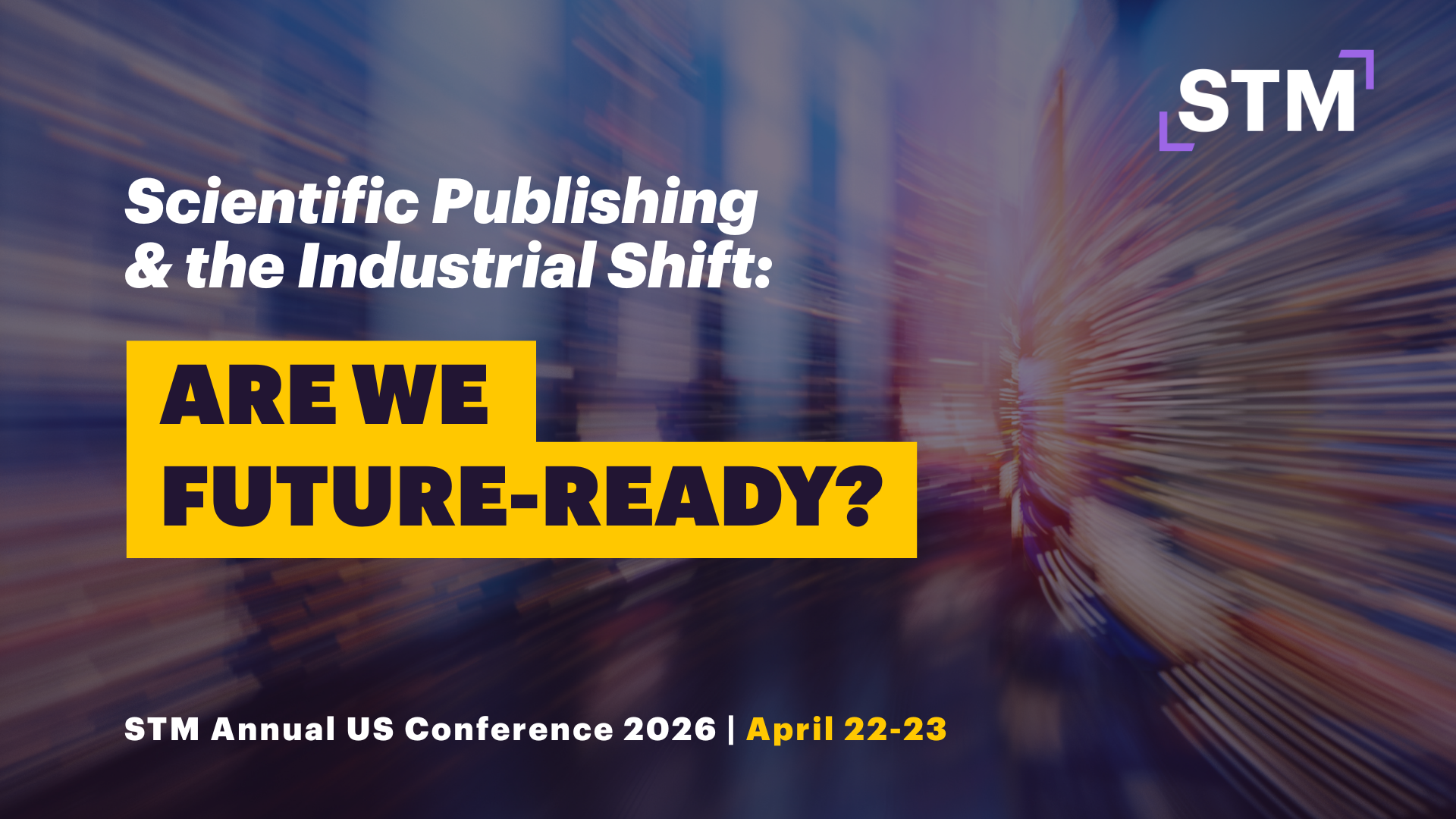
STM 2-day US Annual Conference 2026
Scientific Publishing & the Industrial Shift:
Are We Future-Ready?
Washington, DC | April 22–23, 2026

The research ecosystem is undergoing an industrial shift. Structural pressures — from funding and policy to AI and integrity — are accelerating change across how research is created, validated, and shared. The question is not simply how we respond, but how we lead.
Moments like this call for in-person collaboration — and for new ways of engaging with one another.
What’s this?
Each April, leaders and emerging voices from across the global research ecosystem — publishers, learned societies, university presses, librarians, technology providers, policy experts, government representatives, and research institutions — convene in Washington, DC to examine what this moment requires of us to advance trusted research. This is the STM US Annual Conference — and we hope you will join us.
New formats
In 2026, we are intentionally evolving the format to reflect the scale of change underway. Expect deeper engagement, new interactive sessions, debate, and more opportunity to exchange perspectives across roles and organizations of all sizes.
Join us this April as we work together to strengthen trust, sustain quality, foster innovation, and build resilient systems for the future of research.
Register to join us — and tell your colleagues. (These events tend to sell out!)
Wednesday 22nd April 2026
| 08:00 | Registration & networking breakfast sponsored by Silverchair |
| 09:00 | Opening & welcome and addressing membership Steven Heffner, Chief Publication Officer and Managing Director at IEEE / STM Board Chair Caroline Sutton, CEO, STM |
| 09:45
|
Keynote Speaker
Siva Vaidhyanathan, Robertson Professor of Modern Studies, University of Virginia A thought leader on what happens when Knowledge systems become industrialized, platform-dependent, and algorithmically governed. His work examines how scale, automation, and corporate logics reshape information ecosystems- insights that map directly into the industrial shift now underway in scholarly publishing. |
| 10:30 | Refreshment break & networking sponsored by Copyright Clearance Center |
| 11:00
|
TBC
Moderated by: Simone Taylor, Chief, Publishing, American Psychiatric Association This session will focus more broadly on the theme of the conference (Industrial Shift) and dive into that a bit more deeply to assess what it means for our industry:
We will aim to assess these challenges through the lens of different stakeholders: researchers, librarians, the technology supply chain, and publishers. Panelists: Alexia Hudson-Ward, Dean of Libraries, Georgetown University Jignesh Bhate, CEO, Molecular Connections Rachel Burley, Publisher, American Physical Society |
| 12:00 | Lunch & networking |
| 13:00 – 13:30
|
What publishers bring to the table: Expertise that matters in the AI era
New format: The session opens with a short panel featuring three experts, each representing a core area of publisher value. After the opening discussion, we move into a Gallery walk — attendees split into three groups and rotate through facilitated stations where each panellist leads a deeper dive into their topic with a brief presentation and open Q&A. The session closes with a panel wrap-up where panellists share what they heard and key takeaways. Session facilitator: Apoorva Shah, Vice President of Product Management and UX, Wiley
Session description As AI reshapes research workflows, this session explores the distinctive expertise publishers contribute in an AI-native environment — not features of content distribution, but the capabilities that sustain rigor, context, and reliability across the scholarly record. Rather than focusing on business models or defensive strategies, this session celebrates what publishers do exceptionally well—and explores how to amplify these capabilities in an AI-native ecosystem: Station 1 — Subject matter expertise & brand Publishers cultivate editorial communities with deep domain knowledge — the contextual judgment about what matters, what’s novel, and what’s significant that AI cannot replicate. In a world of content noise and AI-generated volume, publisher brands carry real signal value. This station explores how domain expertise and brand trust work together as a counterforce to undifferentiated content — and why researchers, institutions, and AI systems alike are drawn to trusted names. Station 2 — Editorial excellence, peer review & research integrity The human processes that validate methodology, assess significance, identify conflicts, and maintain rigor — combined with the systems, tools, and cross-publisher collaboration that make trust possible at scale. As AI-generated submissions proliferate and paper mills grow more sophisticated, publisher expertise in quality assurance and integrity infrastructure becomes more critical, not less. This station explores both the editorial craft and the integrity systems that underpin it. Station 3 — Beyond the article The value publishers create extends well beyond the article — into how content is discovered, reused, and consumed by AI systems and new research workflows. As the scholarly record enters these new contexts, the question shifts from technical implementation to shared principles: what values should guide responsible stewardship of content in an AI-native world? This station explores the considerations publishers bring to the table as more stakeholder groups join the conversation — and what it means to lead with values, not just infrastructure. |
| 13:30 |
Station walk: Publisher value in action |
| 14:30 |
Station Synthesis & Close |
| 15:00 | Refreshment break & networking sponsored by Open Pharma |
| 15:45 | Launch of STM Trends panel 2030 Hylke Koers, Chief Information Officer, STM SolutionsPanel moderated by: Heather Staines, Senior Consultant, Delta Think |
| 16:45 | Meeting wrap-up and close with an announcement from the Drinks reception sponsor |
| 17:00 | Drinks Reception sponsored by Wiley Partner Solutions |
Thursday 23rd April 2026
| 08:15 | Light breakfast & networking |
| 09:00 | Discussions with US Staffers |
| 10:00 | Refreshment break & networking sponsored by Copyright Clearance Center |
| 11:00 | TBC |
| 12:00 | Lunch & networking |
| 13:00
|
Transatlantic Approaches to AI in Science – Introducing RAISE
Introduction: Claudia Russo, Director, Public Affairs EU and Global Deputy Director, Public Affairs, STM Dr Florent Bernard, Counsellor for Research and Innovation at the EU Delegation to the US, European Commission This session will explore Europe’s emerging flagship initiative in AI‑driven research—the Resource for AI Science in Europe (RAISE)—and examine how it aligns with and diverges from the United States’ strategic efforts in AI for scientific discovery, including the Genesis mission. RAISE is conceived as a virtual European institute designed to coordinate and pool AI‑related resources across the continent. Built around key pillars—including compute infrastructure (EuroHPC, AI Factories), high‑quality data ecosystems (EOSC, Common Data Spaces, Data Labs), and excellence networks for talent and research—RAISE aims to strengthen Europe’s scientific competitiveness, reduce fragmentation, and ensure that AI adoption in research remains ethical, transparent, and human‑centric. By offering coordinated access to supercomputing, federated datasets, and AI‑ready research environments, RAISE seeks to accelerate scientific discovery and support researchers across all disciplines. Together, RAISE and Genesis underscore an ambition on both sides of the Atlantic to leverage AI as a transformative accelerator for scientific discovery. |
| 14:00
|
The debate: This house believes that innovation in publishing should be managed by specialist teams rather than embedded within existing departments.
Our two speakers will argue for and against the motion, and we’ll take rebuttal questions from the floor. Attendees of the session will vote for the winner. Paul Gee, Vice President, Digital Product Management and Development, The JAMA Network |
| 15:00 | Refreshment break & networking |
| 15:45
|
Navigating uncertainty: Funding volatility, policy shifts, and their impact on scholarly publishing Funding volatility, policy uncertainty, and shifting patterns in research output and scholarly engagement are no longer theoretical risks—they are reshaping the global research ecosystem in real time. In Spring 2025, Delta Think convened approximately 30 participating organizations and surveyed more than 13,000 researchers across 135 countries to establish a baseline understanding of the impacts of recent U.S. policy and funding changes. The study was repeated in Fall 2025, enabling early comparisons and the identification of emerging trendlines across disciplines and regions. This session will present key findings from the research, highlighting where researcher sentiment appears to be stabilizing, where risks remain elevated, and which pressures are proving persistent versus temporary. Speakers will examine how these dynamics are influencing publishing behavior, conference participation, and institutional decision-making. Moving from data to action, panelists will discuss how their organizations are using these insights to inform strategic planning, risk management, and community engagement in an increasingly volatile environment. The session will conclude with an interactive discussion, inviting participants to share their own experiences and perspectives on navigating funding uncertainty and policy change. |
| 16:45 | Closing remarks |
Want to stay in the loop with STM events and timely news updates?
Sign up for our newsletter here
Annual Conference Program Committee:
Lori Carlin, Chief Commercial Officer, Delta Think, Inc.
Donna Okubo, Community Engagement Manager, STM
Christine Reilley, Managing Director, Publishing, American Society of Mechanical Engineers (ASME)
Nancy Roberts, Head of Operations, Maverick Consulting
Apoorva Shah, Vice President of Product Management and UX, Wiley
Amanda Sulicz, Associate Program Manager, Publishing Ethics, IEEE
Simone Taylor, Chief, Publishing, American Psychiatric Association
Helpful information
See here for nearby restaurants
See here for nearby bars & pubs
See here for nearby hotels
See here for the Dulles International Airport and terminal map
See here for the National Press Club “visit us” link for parking and metro information
Event Terms & Conditions
Cancellation
Where an event has registration fees, cancellations made in writing up to 30 days before an event are eligible for a 50% refund. No refunds can be made for cancellations received on or after 30 days prior to the event date, however, substitutions may be made free of charge at any time.
Insurance
Registration fees do not include insurance. Participants are advised to take out adequate personal insurance to cover travel, accommodation, cancellation and personal effects.
Privacy
For more information about the personal data processed by STM Services, please refer to our Privacy statement
Code of Conduct
For details on the professional and ethical standards upheld by STM members, please refer to our Code of Conduct
Event photography notice
Photos or short videos may be taken during STM in-person events to capture highlights and share them through STM’s reports, website, newsletters, or social media. This is done under STM’s legitimate interest in communicating about our activities and fostering community engagement, while respecting individuals’ privacy rights.
If you prefer not to appear in photos or videos, please let a member of staff or the photographer know during the event. For more information, see our Privacy Statement (https://stm-assoc.org/privacy-statement/)