
 JOIN
JOINA recap: STM Integrity & Innovation Days 2025

On 9–10 December 2025, STM’s annual Innovation & Integrity Days brought together publishers, startups, funders, researchers and infrastructure providers for two days of focused, cross-sector collaboration in London.
Now in its third year (building on the legacy of STM Week), this year’s Innovation & Integrity Days reflected a noticeable shift: more dialogue across traditional boundaries, more urgency around shared challenges, and a stronger sense of common purpose in shaping the future of research integrity and innovation — priorities that reflect this year’s theme “Building Tomorrow’s Research Integrity Framework”.
For those unable to join us in London, here are some of the key takeaways and highlights:
Day One: the STM Innovator Fair
The first day of STM’s Innovation & Integrity Days focused on practical progress in innovation — with a keynote, lightning talks, startup pitches and a panel that explored how technology, infrastructure and collaboration are reshaping research integrity.
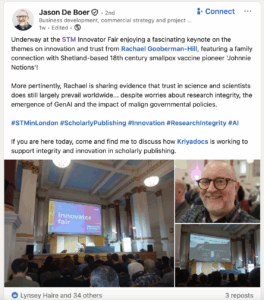 In the opening keynote, Professor Rachael Gooberman-Hill (UK Committee on Research Integrity; University of Bristol) set the tone by drawing on her extensive experience to frame research integrity not as a checklist, but as the long-term work of building and maintaining trust — informed by context, relationships, and values.
The lightning talks that followed showcased a wave of innovation already underway — not just isolated tools, but signals of how the ecosystem is adapting. Key themes included:
- Workflow integration: Platforms like KGL’s Smart Publish, Proofig’s PubShield, Enago Reports, ReviewerZero and Hum’s Alchemist Review demonstrated how multiple integrity signals can be brought together in a single editorial interface. DataSeer’s SnapShot tool demonstrated how agentic LLM technology can be leveraged to support the editorial process and Scitility, a Vesalius Innovation Award finalist, added to the picture with article-level risk scoring based on co-authorship patterns and retractions.
- Upstream provenance: Solutions like Veridat’s Bench and VeriMe are moving trust signals earlier in the process — capturing the when, where and how of data creation, and validating researcher identity in a privacy-preserving way. This was echoed in Thesify AI’s pitch — using structured feedback and journal matching to support quality at submission.
- Reviewer capacity and quality: ReviewerOne, Global Campus and SinoScholar (MPS) explored ways to strengthen reviewer pools through better matching, recognition and AI-assisted support. Profectus Academy, the Vesalius Award winner, connects here too — using real-world examples to build reviewer-like feedback into the research grant writing process.
- AI-readiness, risk awareness and trust: From Cashmere’s work on preparing trusted content for LLMs to Otto-SR’s systematic review support and Dandelion’s visual literature mapping, the ecosystem is thinking ahead. AuthentiSci, another Vesalius finalist, approached this from the public trust angle — enabling ORCID-verified researchers to rate and contextualise science reporting.
The innovations on display reflected a shared aim: to embed trust earlier, deeper and more systematically into the research process — supporting not just editors and research integrity staff, but researchers, reviewers and the public.
The day also featured Karger’s Vesalius Innovation Award, spotlighting early‑stage innovation focused on trust and researcher support. Five finalists pitched from more than 100 applications worldwide; you can learn more about the winner Profectus Academy and the other finalists here.
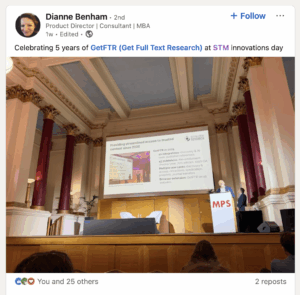 A five-year retrospective on GetFTR offered a compelling testimony of cross-industry collaboration delivering results. Originally launched to streamline access to the version of record from discovery services, GetFTR has evolved into critical infrastructure supporting the discoverability and use of trusted scholarly content in a multitude of ways.
The Fair also created space for practical exchange. Between sessions, attendees connected with exhibitors, explored prototypes and surfaced shared challenges. In parallel, in-person Research Integrity Workshops provided case-based learning in a confidential setting — not covered in this report, but an important part of the day’s impact.
The final session, From Pitch to Partnership, explored how stakeholders assess new ventures. Investors, infrastructure leaders and acquirers shared frank insights: what works, what doesn’t, and how mission-aligned startups can grow without compromising their values.
Taken together, the Innovator Fair pointed to a clear direction of travel: innovation that embeds trust throughout the research lifecycle — supported by smart tools, shared infrastructure, and steady collaboration.
Day Two: Research Integrity Day
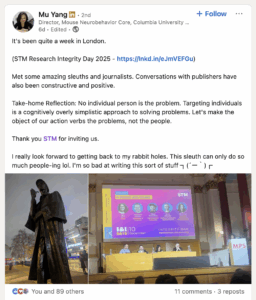
Held under the Chatham House Rule, Day Two of the programme was framed as a multi-stakeholder dialogue — to surface shared concerns, test one another’s assumptions, and discuss practical pathways forward. The day kicked off with an update on the STM Integrity Hub, highlighting the progress that has been made in 2025, and then featured a series of panel discussions that explored various aspects of the “Building Tomorrow’s Research Integrity Framework” theme.
Bringing together publishers, researchers, funders, institutional integrity offices, infrastructure providers and volunteer sleuths, the day focused on how to strengthen trust in research amid evolving threats and expectations. Discussions focused on research integrity, governance and operational practice, and did not cover competitively sensitive topics such as commercial terms. Three key themes emerged:
1/ Shared Responsibility, Misaligned Incentives
Participants acknowledged that every part of the research ecosystem plays a role in upholding integrity — but also faces different incentives and pressures. From grant cycles and publication demands to institutional risk management and business models, aligning integrity incentives emerged as a long-term priority. The discussion pointed to the need for collaboration, not just isolated efforts.
2/ Shift Left: Trust Starts Earlier
 There was strong support for moving integrity checks earlier in the research lifecycle. By the time a publisher’s integrity team gets involved, behaviours are already entrenched and corrections are very cumbersome. Funders and institutional representatives described very low numbers of formal complaints relative to portfolio size, with only a fraction upheld, and pointed to weak whistleblower protections, fear of reprisals and unclear reporting routes as key barriers. Suggested directions included treating role-modelling and local culture as central (not just formal training), exploring continuing professional development requirements for integrity awareness, and tightening channels and protections so that raising concerns is not perceived as a risk to one’s career. Funders described extending grant periods, building in generous leave extensions and placing greater weight on environment and process rather than on publication counts alone. Participants, including sleuths, also called for better protections for those who raise concerns, and for local research cultures that treat integrity as a shared value embedded in everyday practice, rather than a box-ticking exercise.
3/ Upstream Provenance and Workflow Integrity
Several sessions carried forward last year’s Innovation & Integrity days theme of going “beyond the manuscript”. New safeguards, in addition to checking manuscripts at the point of submission for indications of integrity concerns, are required to establish the veracity and authenticity of research outputs, especially in the age of (Gen)AI. Two options were discussed specifically: strengthening researcher identity verification, and establishing the authenticity of images and data through new technologies. Participants agreed that it will be increasingly challenging for detection to keep pace with manipulation as tools evolve, which requires us to focus our attention on provenance — capturing how and where data and images are created, and embedding that information into research workflows from the outset. Ideas included trusted research environments, data-focused peer review, and stronger signalling of provenance quality, aligned with Open Science principles. In other words, a shift from publishers investigating if something is false or fabricated, to researchers demonstrating that something is real and genuine through trustworthy workflows – requiring collaboration and new workflows throughout the research ecosystem.
A Way Forward
One clear takeaway from both days: technology can support integrity, as proven by the success of the STM Integrity Hub and the many innovators presenting their work, but it cannot guarantee it. Lasting trust depends on governance, incentives, new technologies, workflows, and especially collaboration.
STM remains committed to supporting that progress — convening dialogue, connecting expertise, and championing efforts that protect and enhance the integrity of the scholarly record.
Special thanks to Lynsey Haire, Academic Publishing Operations Consultant, for her expert summary and contribution to this post following STM’s I&I Days in London.
—
Want to be sure you don’t miss next year’s event? (Hint: it will be in early December 2026 at the BMA House again!) Sign up for our newsletter so you can be the first to know when registration opens — and when virtual learning opportunities emerge.