



Gold represents those publications where the final published version of an article (Version of Record) is freely and permanently available online immediately on publication for anyone, anywhere to read. This includes articles in hybrid journals. See Methodology and Notes for more information.
Green represents those publications where a version of an article is publicly shared online, often as an Accepted Manuscript. To support a sustainable business model, publishers may maintain an embargo and/or may retain an Exclusive License to Publish. Articles, reviews and conference papers are counted as Green open access only if they are not also Gold. See Methodology and Notes for more information.
Bronze represents those publications that are made free-to-read on the publisher’s website, but are not identified as gold for one of the following reasons: access for a limited duration, an unclear license, or a license that is clear but is not a Creative Commons license. See Methodology and Notes for more information.
Subscription-only represents those publications that are available through individual or institutional subscriptions, individual purchases, or other programs (e.g. Research4Life) but not available through Open Access. See Methodology and Notes for more information.


Gold is, by far, the dominant type of open access (OA) 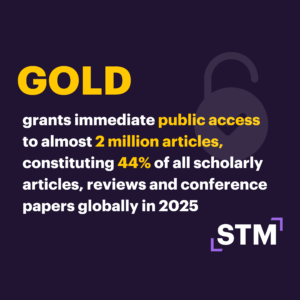
…granting immediate public access to almost 2 million articles, constituting 44% of all scholarly articles, reviews and conference papers published globally in 2025. Gold has been widely embraced by the research community because it delivers the Version of RecordThe final and most authoritative fixed version of a journal article that has been made available by any organisation that acts as a publisher by formally and definitively declaring the article “published”. Publishers take responsibility for this article version, and it is the article version the author as a scientist will be measured against, that will display corrections and that permanently enters the “record of science” for posterity. to maintain quality and research integrity and represents a sustainable and scalable means to deliver publishing services.
Gold represents those publications where the final published version of an article (Version of Record) is freely and permanently available online immediately on publication for anyone, anywhere to read. This includes articles in hybrid journals. See Methodology and Notes for more information.
Green represents those publications where a version of an article is publicly shared online, often as an Accepted Manuscript. To support a sustainable business model, publishers may maintain an embargo and/or may retain an Exclusive License to Publish. Articles, reviews and conference papers are counted as Green open access only if they are not also Gold. See Methodology and Notes for more information.
Bronze represents those publications that are made free-to-read on the publisher’s website, but are not identified as gold for one of the following reasons: access for a limited duration, an unclear license, or a license that is clear but is not a Creative Commons license. See Methodology and Notes for more information.
Subscription-only represents those publications that are available through individual or institutional subscriptions, individual purchases, or other programs (e.g. Research4Life) but not available through Open Access. See Methodology and Notes for more information.
Gold is, by far, the dominant type of open access (OA)
…granting immediate public access to almost 2 million articles, constituting 44% of all scholarly articles, reviews and conference papers published globally in 2025. Gold has been widely embraced by the research community because it delivers the Version of RecordThe final and most authoritative fixed version of a journal article that has been made available by any organisation that acts as a publisher by formally and definitively declaring the article “published”. Publishers take responsibility for this article version, and it is the article version the author as a scientist will be measured against, that will display corrections and that permanently enters the “record of science” for posterity. to maintain quality and research integrity and represents a sustainable and scalable means to deliver publishing services.
Gold represents those publications where the final published version of an article (Version of Record) is freely and permanently available online immediately on publication for anyone, anywhere to read. This includes articles in hybrid journals. See Methodology and Notes for more information.
Green represents those publications where a version of an article is publicly shared online, often as an Accepted Manuscript. To support a sustainable business model, publishers may maintain an embargo and/or may retain an Exclusive License to Publish. Articles, reviews and conference papers are counted as Green open access only if they are not also Gold. See Methodology and Notes for more information.
Bronze represents those publications that are made free-to-read on the publisher’s website, but are not identified as gold for one of the following reasons: access for a limited duration, an unclear license, or a license that is clear but is not a Creative Commons license. See Methodology and Notes for more information.
Subscription-only represents those publications that are available through individual or institutional subscriptions, individual purchases, or other programs (e.g. Research4Life) but not available through Open Access. See Methodology and Notes for more information.
A comparison of year-on-year growth in gold OA and subscription-only articles shows the same broad patterns of OA uptake affecting both Europe, where OA uptake is high, and Asia, where OA uptake is relatively low as a percentage share of all articles over the period. In fact, the ten-year-CAGR for gold OA in Asia is 20%, which is higher than in Europe, at 17%. Where the two regions diverge is growth in subscription-only articles. In Asia, subscription-only articles have a ten-year-CAGR of 10%, whereas for Europe, this is -4%. OA uptake began earlier in Europe than in Asia, and the two regions have followed different trajectories since. Furthermore, gains in gold OA uptake in Asia are offset by continued growth in subscription-only articles. This is likely due to the speed of total output growth, driven primarily by China and India.
Gold represents those publications where the final published version of an article (Version of Record) is freely and permanently available online immediately on publication for anyone, anywhere to read. This includes articles in hybrid journals. See Methodology and Notes for more information.
Green represents those publications where a version of an article is publicly shared online, often as an Accepted Manuscript. To support a sustainable business model, publishers may maintain an embargo and/or may retain an Exclusive License to Publish. Articles, reviews and conference papers are counted as Green open access only if they are not also Gold. See Methodology and Notes for more information.
Bronze represents those publications that are made free-to-read on the publisher’s website, but are not identified as gold for one of the following reasons: access for a limited duration, an unclear license, or a license that is clear but is not a Creative Commons license. See Methodology and Notes for more information.
Subscription-only represents those publications that are available through individual or institutional subscriptions, individual purchases, or other programs (e.g. Research4Life) but not available through Open Access. See Methodology and Notes for more information.
Gold is, by far, the dominant type of open access (OA)
…granting immediate public access to almost 2 million articles, constituting 44% of all scholarly articles, reviews and conference papers published globally in 2025. Gold has been widely embraced by the research community because it delivers the Version of RecordThe final and most authoritative fixed version of a journal article that has been made available by any organisation that acts as a publisher by formally and definitively declaring the article “published”. Publishers take responsibility for this article version, and it is the article version the author as a scientist will be measured against, that will display corrections and that permanently enters the “record of science” for posterity. to maintain quality and research integrity and represents a sustainable and scalable means to deliver publishing services.
Gold represents those publications where the final published version of an article (Version of Record) is freely and permanently available online immediately on publication for anyone, anywhere to read. This includes articles in hybrid journals. See Methodology and Notes for more information.
Green represents those publications where a version of an article is publicly shared online, often as an Accepted Manuscript. To support a sustainable business model, publishers may maintain an embargo and/or may retain an Exclusive License to Publish. Articles, reviews and conference papers are counted as Green open access only if they are not also Gold. See Methodology and Notes for more information.
Bronze represents those publications that are made free-to-read on the publisher’s website, but are not identified as gold for one of the following reasons: access for a limited duration, an unclear license, or a license that is clear but is not a Creative Commons license. See Methodology and Notes for more information.
Subscription-only represents those publications that are available through individual or institutional subscriptions, individual purchases, or other programs (e.g. Research4Life) but not available through Open Access. See Methodology and Notes for more information.
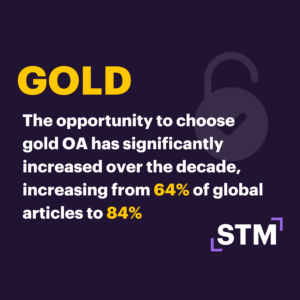 The opportunity to publish gold Open Access has increased rapidly.
The progress of open access is being held back by authors continued selection of subscription-only publication routes. However, as the data supports, the number of authors that choose gold OA continues to climb. In 2015, 64% of global articles, reviews, and conference papers either were or could have been published as gold OA articles. This figure rose to 84% by 2025, a difference of 20%.
In 2025, almost 1.7 million articles could have been published gold OA but were not. Eighty four percent of global articles, reviews and conference papers in total could have been gold OA. The number of articles for which gold OA was an option but was not selected has a CAGR of 3% over the period, lower than the 5% growth rate for total global articles, reviews and conference papers.
Gold represents those publications where the final published version of an article (Version of Record) is freely and permanently available online immediately on publication for anyone, anywhere to read. This includes articles in hybrid journals. See Methodology and Notes for more information.
Green represents those publications where a version of an article is publicly shared online, often as an Accepted Manuscript. To support a sustainable business model, publishers may maintain an embargo and/or may retain an Exclusive License to Publish. Articles, reviews and conference papers are counted as Green open access only if they are not also Gold. See Methodology and Notes for more information.
Bronze represents those publications that are made free-to-read on the publisher’s website, but are not identified as gold for one of the following reasons: access for a limited duration, an unclear license, or a license that is clear but is not a Creative Commons license. See Methodology and Notes for more information.
Subscription-only represents those publications that are available through individual or institutional subscriptions, individual purchases, or other programs (e.g. Research4Life) but not available through Open Access. See Methodology and Notes for more information.
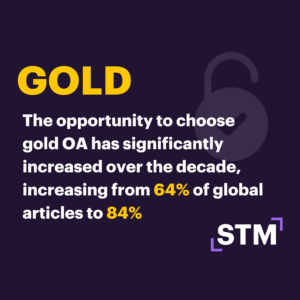 The opportunity to publish gold Open Access has increased rapidly.
The progress of open access is being held back by authors continued selection of subscription-only publication routes. However, as the data supports, the number of authors that choose gold OA continues to climb. In 2015, 64% of global articles, reviews, and conference papers either were or could have been published as gold OA articles. This figure rose to 84% by 2025, a difference of 20%.
In 2025, almost 1.7 million articles could have been published gold OA but were not. Eighty four percent of global articles, reviews and conference papers in total could have been gold OA. The number of articles for which gold OA was an option but was not selected has a CAGR of 3% over the period, lower than the 5% growth rate for total global articles, reviews and conference papers.
Gold represents those publications where the final published version of an article (Version of Record) is freely and permanently available online immediately on publication for anyone, anywhere to read. This includes articles in hybrid journals. See Methodology and Notes for more information.
Green represents those publications where a version of an article is publicly shared online, often as an Accepted Manuscript. To support a sustainable business model, publishers may maintain an embargo and/or may retain an Exclusive License to Publish. Articles, reviews and conference papers are counted as Green open access only if they are not also Gold. See Methodology and Notes for more information.
Bronze represents those publications that are made free-to-read on the publisher’s website, but are not identified as gold for one of the following reasons: access for a limited duration, an unclear license, or a license that is clear but is not a Creative Commons license. See Methodology and Notes for more information.
Subscription-only represents those publications that are available through individual or institutional subscriptions, individual purchases, or other programs (e.g. Research4Life) but not available through Open Access. See Methodology and Notes for more information.
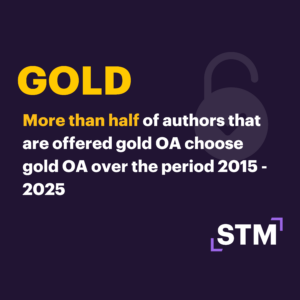 Authors are increasingly choosing gold OA when it is offered.
In 2015, 27% of publications for which the author was offered the option of gold OA were published gold; by 2025, this figure had almost doubled to 52%.

