

OA DASHBOARD
Open Access Data and the Publishing Industry
As Open Access (OA) has continued to evolve — the form it is taking is not homogenous, neither in terms of geography nor research discipline. During this time, publishers have worked to rapidly expand opportunities by providing new pathways to publish OA, developing new business models, and by facilitating other collaborations and initiatives that support Open Science more broadly.
Key takeaways & trends in the data
Evident in the data collected is that significant progress has been made over the last ten years toward full Open Access. The charts provided in this dashboard illustrate that gold is the greatest contributor to progress across global regions, top article-producing countries/regions, disciplines, and publications based on research funded by the top global funders. This dashboard also demonstrates a significant increase in the opportunity for an author to choose gold OA across the ten-year period.
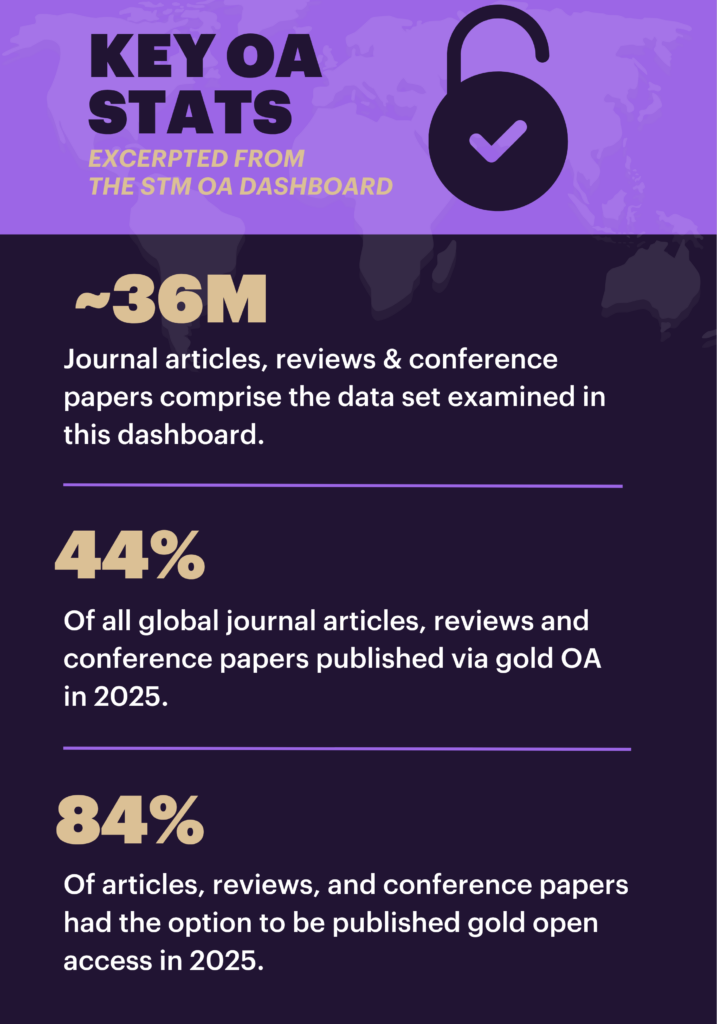
- In 2025, 44% of all 4.2M global journal articles, reviews and conference papers were published as immediately available, freely accessible, Version of RecordThe final and most authoritative fixed version of a journal article that has been made available by any organisation that acts as a publisher by formally and definitively declaring the article “published”. Publishers take responsibility for this article version, and it is the article version the author as a scientist will be measured against, that will display corrections and that permanently enters the “record of science” for posterity. via gold OA.
- An additional 6% were made freely accessible, though not necessarily as a Version of Record, by subscription- or revenue-supported types of OA known as green and bronze. This comprises 3% made available in repositories either as an earlier version of the article (known as an Accepted Manuscript) or a Version of Record under what is commonly referred to green OA. A further 3% were made available as free-to-read on a publisher’s website by what is known as bronze OA.
- In 2025, gold OA was an option for 84% of global articles.
- The data suggests that gold OA moved from a rapid expansion phase (2016–2021) to a more mature growth phase (2022–2025). Early growth was driven by expanding OA options, transformative agreements, funder mandates and the rise of OA-only publishers. Growth subsequently moderated as OA reached a larger share of the market, while strong publication growth in countries with lower OA uptake has helped sustain subscription-only output. Despite this steady maturing, gold OA continues to grow substantially faster than subscription-only publishing and remains the principal driver of the global transition toward open access.

This work is licensed under a Creative Commons Attribution-NonCommercial 4.0 International License.
Charts created using https://flourish.studio
